

Professional Smart Home vs DIY: What's the Real Cost Difference in Australia?
The pitch for DIY smart home is compelling: buy a few smart bulbs, a Google Nest thermostat, a cheap security camera, spend a weekend on YouTube, and you have a smart home for $2,000. The pitch for a professional system like Control4 sounds like the opposite: pay a dealer $50,000 to do things you could theoretically do yourself. So what are you actually paying for, and is it worth it? Here's an honest breakdown — costs included.

The DIY Smart Home: What It Actually Costs
Let's be honest about DIY. There's a wide spectrum from "smart bulb in the bedroom" to "full Home Assistant installation with MQTT, ZigBee, Z-Wave, and custom dashboards." For this comparison, we're looking at a reasonably capable DIY smart home in a 4-bedroom Sydney house — one that covers lighting, climate, security, and some audio. Not just smart bulbs.
DIY System: Hardware Costs
| Component | DIY Option | Cost (AUD) |
|---|---|---|
| Smart lighting (10 zones, ZigBee or Wi-Fi) | Philips Hue, IKEA Tradfri, or Aqara dimmers | $800–$3,000 |
| HVAC (Daikin ducted system) | Daikin BRP adapter + Home Assistant integration | $150–$400 |
| Security cameras (4 cameras) | Reolink, Hikvision, or Frigate NVR setup | $600–$2,000 |
| Doorbell + smart lock | Ring, Eufy, or Yale Assure | $400–$900 |
| Multi-room audio | Sonos or Amazon Echo speakers | $1,200–$4,000 |
| Home automation hub | Home Assistant Green + Zigbee dongle | $250–$500 |
| Wi-Fi router / mesh | TP-Link Deco, Eero, or Asus ZenWiFi | $400–$1,200 |
| Hardware total | $3,800–$12,000 |
DIY System: Hidden Costs
Here's what most DIY cost comparisons leave out:
- Your time — setup: A capable Home Assistant system takes 40–100+ hours to properly configure, depending on complexity. At a modest $80/hr, that's $3,200–$8,000 of your time.
- Your time — ongoing maintenance: DIY smart home systems require ongoing attention. Software updates, broken integrations, hardware failures, and adding new devices typically consume 2–5 hours per month. Over 5 years, that's 120–300 hours.
- Electrician costs: Most smart light switches in Australia require a neutral wire, which many older homes don't have at the switch. Running neutral wires typically costs $150–$350 per circuit. For 10 circuits, that's $1,500–$3,500 in electrical work.
- Incompatibility failures: Smart home devices from different ecosystems don't always play together. Expect to buy and return at least a few devices that don't work as advertised. Budget $300–$800 for failed experiments.
- Replacement and upgrades: Consumer smart home hardware has shorter product lifecycles than professional hardware. Expect to replace components every 3–5 years as products are discontinued.
The Professional System: What You're Actually Paying For
A professional Control4 installation for the same 4-bedroom Sydney home — covering lighting, climate, audio, cinema, security cameras, and intercom — typically costs $40,000–$80,000 fully installed. That's a significant gap from the DIY estimate, so it's worth understanding what's in that cost.

What a Professional Installation Includes
| What you pay for | What it includes |
|---|---|
| System design | A professional designs the system from scratch — right product choices, correct wiring plan, zone mapping, scene logic, network architecture |
| Commercial-grade hardware | Control4 hardware is built for 10+ year service life, not the 3-year consumer product cycle. Dimmers handle full load, controllers are rack-mounted with UPS backup |
| Professional networking | Ubiquiti UniFi switches, APs, and firewall configured for the smart home's specific requirements — VLANs, QoS, and security properly set up |
| Certified installation | All electrical work completed by licensed electricians; all cabling to Australian standards; no DIY workarounds that void warranties or contravene AS/NZS 3000 |
| Expert programming | Someone who programs Control4 systems full-time sets up your automations, scenes, and interfaces — not someone learning as they go |
| Handover and training | Your family is trained to use the system before the installer leaves |
| Ongoing support | A real human you can call when something doesn't work — phone support, remote access, and onsite visits when needed |
The Real Comparison: 5-Year Total Cost
The most honest comparison looks at the total cost over a meaningful time period. Let's look at 5 years for both systems:
| Cost Category | DIY System | Control4 Professional |
|---|---|---|
| Initial hardware + installation | $8,000–$18,000 | $40,000–$80,000 |
| Your time — 5 years (200 hrs @ $80/hr) | $16,000 | ~$0 (system runs itself) |
| Annual service agreement | $0 | $500–$2,000/yr ($2,500–$10,000) |
| Hardware replacements (discontinued products) | $1,500–$5,000 | Minimal (long product lifecycle) |
| Electrician / ad-hoc repairs | $1,000–$3,000 | Covered under service agreement |
| 5-year total | $26,500–$42,000 | $42,500–$90,000 |
The gap narrows considerably once time is valued honestly. And it narrows further once you account for quality differences — a professional Control4 system integrated with a properly configured Ubiquiti UniFi network doesn't go offline when your ISP has a blip, doesn't require you to restart the hub to get the lights working, and doesn't require you to debug a broken ZigBee pairing at 7am before work.
For full smart home pricing context, see our comprehensive smart home cost guide for 2026.
The Reliability Gap
This is the factor most cost comparisons skip. A professional Control4 system is designed to be reliable first. The hardware is tested under load, the programming is verified, the network infrastructure is purpose-built. When we install a system, we're staking our reputation on it working when the client comes home. The business model requires reliability.
A DIY system's reliability depends entirely on the skills and time investment of the builder. Many Home Assistant enthusiasts run excellent, stable systems. But 'excellent and stable' for a tech enthusiast who enjoys maintaining it is a different benchmark from a spouse who just wants the lights to work.
What Professional Installation Does Better
Scenes That Actually Work
A Control4 'Good Morning' scene reliably does the same thing every time: lights at the right level, HVAC to the right temperature, blinds open, your playlist on. Programming a reliable scene in a DIY system is possible, but requires understanding timing, state management, and how each integration behaves — knowledge that takes time to develop.
AV Integration
This is where professional systems genuinely exceed what DIY can deliver. Control4's depth of AV driver support — controlling Denon, Sony, Epson, Samsung, Panasonic, and dozens of other brands at a granular level — has no equivalent in the DIY world. Browse our audio collection to see the depth of what's available.
New Build Integration
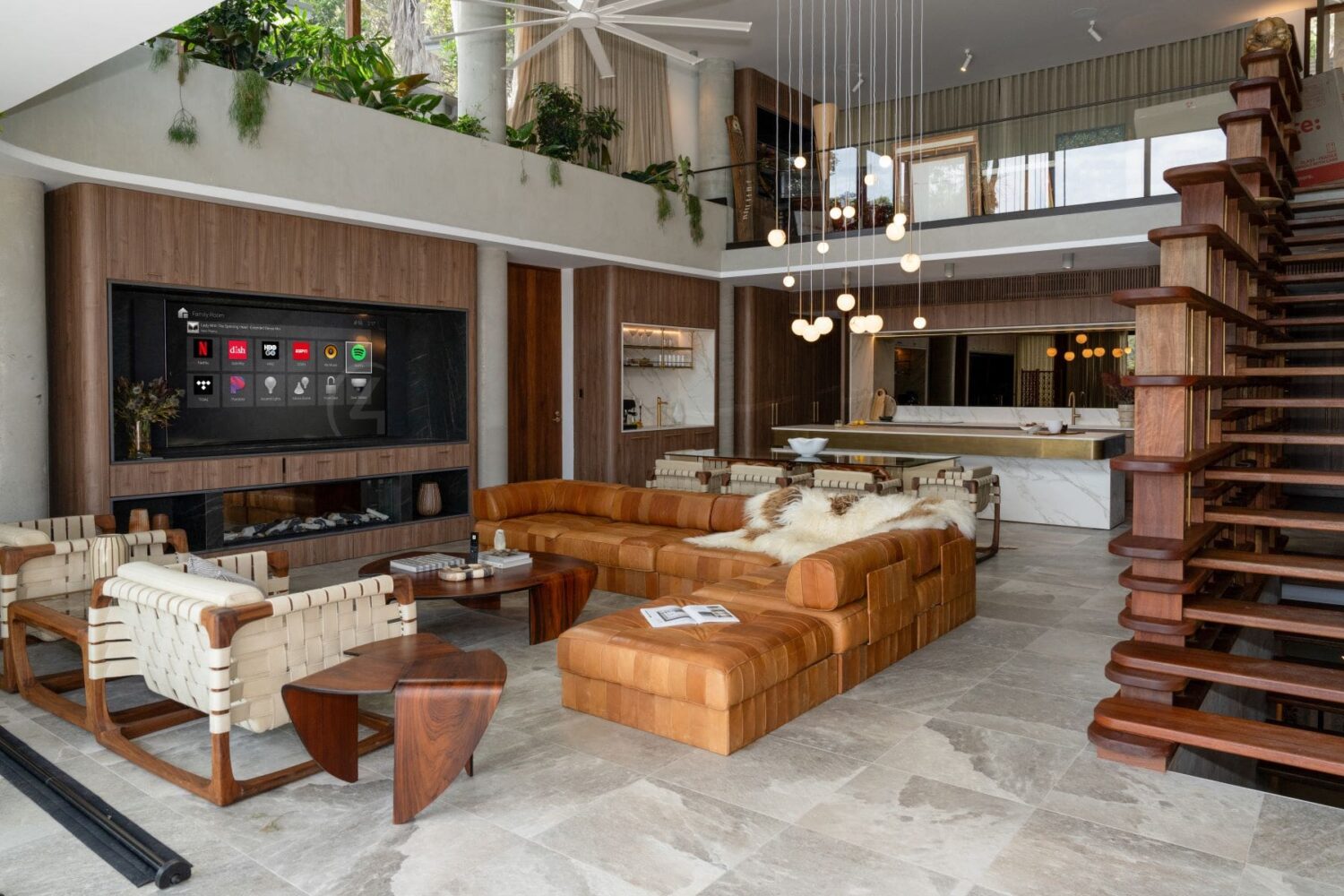
If you're building a new home, a professional system delivers something a DIY system can't: infrastructure designed from the start. CAT6 to every room, speaker cable pre-run in ceilings, wall plates in the right locations, a dedicated rack in the comms room — all specified before the builder frames the walls. That infrastructure has value for the life of the home. DIY in a new build usually means wireless workarounds because the cabling wasn't planned. See our guide on planning smart home automation in a Sydney home.
When DIY Makes Sense
There are situations where DIY is the right call:
- You're renting and can't modify the property — wireless smart plugs and smart bulbs make sense
- You're a technical professional who genuinely enjoys this kind of project and has time
- You're in an older home where structural limitations make professional installation impractical
- Your budget genuinely doesn't extend to professional installation and a capable DIY system is better than nothing
- You want niche integrations (solar monitoring, EV charging, energy tariff automation) that professional platforms don't yet support well
When Professional Makes Sense
- You're building a new home — get the infrastructure right from the start
- Your household includes non-technical users who need everything to work without any administration
- You have a home cinema or serious AV setup that needs deep, reliable control
- You value your time more than the cost difference
- You want a system that increases the value and appeal of the property
- You want one company responsible for everything, including when something goes wrong
We also compare professional platforms side-by-side in our Control4 vs Savant vs Crestron guide.
FAQ: Professional vs DIY Smart Home Australia
Can I start DIY and upgrade to professional later?
Yes, but with caveats. If you install wireless DIY smart switches and then later want a professional system, those switches often need to be replaced entirely. Control4 doesn't integrate with most consumer smart home hardware — it uses its own hardware ecosystem. The transition from DIY to professional typically involves replacing a significant proportion of devices. The one exception: networking. A Ubiquiti UniFi network you install yourself is the same infrastructure we'd use for Control4, so that investment carries forward.
What's the minimum professional smart home cost in Australia?
A legitimate professional Control4 entry system for a single area — typically a living room with lighting control, AV integration, and streaming — starts at around $5,000–$8,000 installed. A whole-home system covering lighting, HVAC, audio, and security starts at $30,000–$40,000 for a modest-sized Sydney home. See our full pricing guide for detailed breakdowns.
Does a professional smart home add value to a property?
Yes — if it's a recognised platform like Control4. A well-installed, documented Control4 system is a selling point in the Sydney market, particularly at the premium end. Real estate agents in the Eastern Suburbs and North Shore regularly cite home automation as a value-add for prestige listings. A DIY system of assorted brands and apps is harder to convey to buyers and often doesn't add equivalent value.
What happens if Control4 goes out of business?
Control4 is owned by Snap One, a publicly traded US company with 3,500+ dealers and a major commercial business. The platform has been operational since 2003. In the unlikely scenario that it was discontinued, existing systems would continue to function — they don't rely on cloud connectivity for core operation. The main impact would be no new software updates and reduced dealer availability for changes. This risk exists for any proprietary platform, including Apple, Google, and Amazon's home ecosystems.
Book Your Free Consultation →