

Control4 vs KNX: Open Standard vs Proprietary Platform — Which Is Right for Your Australian Home?
When you're investing $50,000 or more in a whole-home automation system, the choice of platform isn't just a technical decision — it's a long-term commitment. Two of the most serious contenders for high-end residential and commercial projects in Australia are Control4 and KNX. One is a tightly integrated proprietary ecosystem backed by a global dealer network. The other is a vendor-neutral open standard used on more than 700 million devices worldwide. Neither is wrong. But they suit very different projects, budgets, and expectations.
This guide breaks down exactly how they compare — not in marketing language, but in the practical terms that matter for a new build in the Hills District or a luxury apartment renovation in Pyrmont.

What Is KNX?
KNX is an international open standard (ISO/IEC 14543-3) for building and home automation. Originally developed in Europe in the 1990s, it's now used in over 90 countries and supported by more than 500 manufacturers including ABB, Siemens, Schneider Electric, Gira, and Jung. In Australia, KNX is most common in commercial buildings, hotels, and prestige residential new builds — particularly those designed by European-trained architects or built by developers with European ties.
The core principle of KNX is openness. Any certified KNX device from any manufacturer can communicate with any other KNX device. If ABB makes a great dimmer but Jung makes better keypads, you can mix them freely. The system is programmed using ETS (Engineering Tool Software), a Windows-based application that requires significant training to use effectively. KNX wiring uses a dedicated twisted-pair bus cable (TP-KNX or 'green cable') that runs throughout the home and connects every device on a common network.
What Is Control4?
Control4 is a proprietary smart home platform owned by Snap One, with more than 500,000 installations worldwide. Unlike KNX, Control4 operates as a closed ecosystem — all programming is done through its Composer software, which is exclusively accessible to certified Control4 dealers like us. The platform integrates with over 15,000 third-party devices through official drivers, and supports a wide range of networking, lighting, audio, security, and HVAC systems.
Control4 can run over both wired (Ethernet-based Control4 infrastructure) and wireless networks, making it well-suited to retrofits as well as new builds. You can read more in our guide to what Control4 actually is and how it works in Australia.
Control4 vs KNX: Side-by-Side Comparison
| Factor | Control4 | KNX |
|---|---|---|
| Standard | Proprietary (Snap One) | Open international standard (ISO) |
| Programming | Control4 Composer (dealer only) | ETS software (KNX certified installers) |
| Wiring required | No (Ethernet + wireless), but CAT6 recommended | Yes — dedicated KNX TP bus cable throughout |
| Retrofit suitability | Excellent — works in existing homes | Difficult — requires running new cable |
| User interface | Polished app, touchscreens, keypads, voice | Varies by manufacturer; often needs a visualisation layer |
| Third-party integrations | 15,000+ devices via official drivers | 500+ manufacturers; very broad hardware choice |
| AV / media control | Excellent — native Sonos, Apple TV, Denon, LG, Sony | Limited — KNX is primarily for building services |
| HVAC integration | Excellent — native Daikin, Mitsubishi, Actron support | Good — via BACNET or brand gateways |
| Long-term vendor risk | Depends on Snap One's continuity | Very low — open standard, multi-vendor |
| Entry-level project cost (AUD) | From $5,000–$15,000 | From $25,000+ (wiring + hardware) |
| Whole-home cost (AUD) | $30,000–$125,000+ | $50,000–$200,000+ |
The Wiring Question
This is often the deciding factor. KNX requires a dedicated twisted-pair bus cable run to every device — every switch, sensor, actuator, and controller. In a new build, this adds roughly 15–25% to the cabling cost but delivers exceptional reliability and speed. In an existing home, it's extremely disruptive, often requiring walls to be opened and replastered.
Control4, by contrast, can operate across your existing home network (wired or wireless). We typically specify a Ubiquiti UniFi network as the backbone — a properly configured UniFi system gives Control4 the low-latency, reliable infrastructure it needs without laying a separate bus cable. For retrofit projects across inner Sydney suburbs like Balmain, Leichhardt, or Newtown, this difference is decisive.
For more on how wiring affects your choices, see our detailed post on smart home automation in Sydney homes.
User Experience: Where Control4 Wins
KNX is fundamentally a building automation protocol — it was designed for commercial buildings before smartphones existed. The hardware is excellent (Gira and Jung keypads are arguably the best-feeling wall switches available), but the end-user experience depends entirely on what visualisation layer is added on top. A standalone KNX system has no native app, no voice control, no media integration. You need to layer a secondary platform (like Gira HomeServer, Loxone, or a HEOS integration) to get a usable interface.
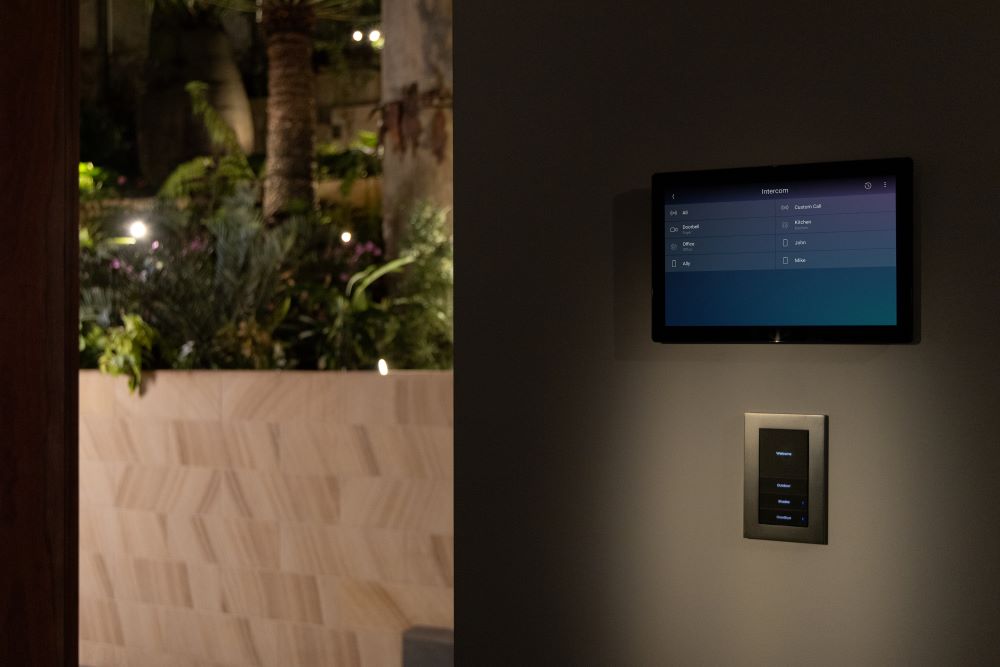
Control4 has invested heavily in its user experience from day one. The Control4 app is clean, consistent, and available on iOS, Android, and Amazon Fire. It controls lighting, climate, security cameras, music, and cinema from a single interface. For the homeowner who just wants everything to work from their phone without understanding what's happening underneath, Control4 is the more intuitive choice.

Media and AV Integration
This is where the gap between the two platforms is most pronounced. Control4 was built with AV integration as a core feature. It natively controls Sonos multi-room audio, Apple TV, PlayStation, Denon and Marantz receivers, Sony and LG televisions, Blu-ray players, and streaming services. A Control4 scene called 'Movie Night' can dim the lights, drop the projector screen, switch the AV receiver to the correct input, set the temperature, and start your streaming platform — all from a single button press.
KNX has virtually no native AV capability. There are gateways and drivers available to bridge KNX to IP-based media systems, but this requires additional hardware and programming. If media control is important to you, Control4 is the better platform. If you're designing a commercial building where the priority is lighting control, HVAC management, access control, and energy monitoring, KNX's strengths are more relevant.
Browse our multi-room audio collection to see what's available through a Control4 system.
Dealer Availability in Australia
KNX installers are less common in Australia than in Europe. There are certified KNX partners in Sydney, but the pool is smaller and often skews commercial (offices, hotels, retail). For residential projects, finding someone with deep KNX residential programming experience in NSW is harder than finding a Control4 dealer.
Control4 has a well-established dealer network across Australia. As a Control4 Platinum Dealer — the highest tier in the Control4 partner programme — we provide full design, supply, installation, and ongoing support from our Alexandria showroom. The Platinum tier reflects both our technical certifications and our volume of completed projects.
Long-Term Flexibility and Vendor Risk
One genuine advantage of KNX is its openness. If the company that programmed your KNX system closes tomorrow, you can hire any KNX-certified installer in the world to work on it. The ETS project file is portable. You own your configuration.
With Control4, you're dependent on the Control4 ecosystem and your dealer for ongoing changes. If a dealer retires or closes, you need to find another certified dealer — which is possible, but takes time. Snap One (Control4's parent) has over 2,800 dealers globally and has shown consistent product support since 2003, but it's a fair concern to raise.
Our view: for a residential home, the superior user experience and easier retrofit of Control4 outweigh the theoretical openness advantage of KNX. For a commercial building with a 30-year design life and a facilities management team, KNX's portability is more compelling.
Cost Comparison for a Typical Sydney Home
For a 4-bedroom home in a Sydney suburb like Mosman or Hunters Hill, here's a realistic cost breakdown:
| Scope | Control4 (AUD) | KNX (AUD) |
|---|---|---|
| Lighting control (12 zones) | $8,000–$14,000 | $18,000–$30,000 |
| HVAC (Daikin multi-zone) | $3,000–$6,000 (driver + interface) | $5,000–$10,000 (gateway + programming) |
| Multi-room audio (Sonos 6 zones) | $8,000–$15,000 | $12,000–$22,000 (separate system needed) |
| Cinema / AV control | $5,000–$12,000 | $10,000–$20,000+ (bridge systems) |
| Controller + networking | $5,000–$10,000 | $8,000–$15,000 |
| Typical total | $35,000–$65,000 | $60,000–$120,000 |
These are indicative ranges. The KNX premium reflects the cost of bus cabling, more complex programming, and often premium European hardware. For full pricing context across all system tiers, see our guide to smart home costs in Australia.
When to Choose KNX
- You're building a new home and want the most technically robust wired platform available
- The project is commercial, hospitality, or multi-tenancy residential (apartments, boutique hotels)
- Your architect or builder has specified KNX and the infrastructure is already planned
- AV and media control are low priorities — you just want switches, sensors, HVAC, and access control
- Long-term vendor independence is more important than user experience quality
When to Choose Control4
- You want the best integrated AV and smart home experience available
- You're retrofitting an existing home and can't run new cable
- You want a polished, consistent app and intuitive scenes for the whole family
- Your project includes a home cinema, multi-room Sonos audio, or video matrix switching
- You want a single dealer who can design, install, and support the whole system
FAQ: Control4 vs KNX Australia
Can Control4 and KNX work together?
Yes. Control4 has a KNX driver that allows it to communicate with a KNX system via an IP gateway. Some high-end projects use KNX for the low-level building infrastructure (lighting circuits, HVAC, blinds) and Control4 as the user-facing control layer on top. This is more common in commercial projects than residential, and adds cost and complexity — but it's a legitimate approach for projects that need the strengths of both.
Is KNX available in Australia?
Yes, KNX is available in Australia and there are certified KNX partners in Sydney, Melbourne, and Brisbane. However, the residential installer ecosystem is smaller than in Europe, and finding a KNX programmer with strong residential experience in NSW takes more effort than finding a Control4 dealer. The hardware also tends to be imported, which can affect lead times and warranty support.
Which platform has better reliability?
Both are extremely reliable in properly designed installations. KNX's wired bus architecture is inherently more robust than wireless, and the distributed device intelligence means no single point of failure. Control4 on a properly configured Ubiquiti UniFi network is also very reliable in practice. The larger risk with Control4 is dependence on the local network; a router reboot can briefly affect device control. KNX operates independently of IP networking for its core functions.
Can I add KNX devices to my Control4 system later?
Yes, through the KNX driver. But if you're planning from scratch, it's usually better to commit to one platform or use KNX for infrastructure and Control4 for the UI from the start, rather than adding KNX devices piecemeal later.
What's the best choice for a luxury new build in Sydney?
For most luxury residential new builds in Sydney — a 4–6 bedroom home in the Eastern Suburbs, North Shore, or Hills District — we typically recommend Control4 as the primary control platform, with Ubiquiti networking and either DALI lighting or Control4 lighting. KNX makes more sense if the project has a European design team, commercial-grade building management requirements, or a specific mandate for open-standard infrastructure.
Book Your Free Consultation →